
The End of Aspirational Travel: Gen Z Re-Classifies Experience Assets

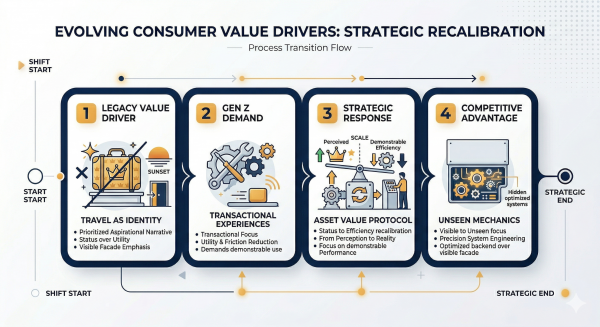
THE SIGNAL: The historical travel industry playbook, heavily reliant on Millennial aspirational branding and social validation through documentation, is obsolete for the next major consumer segment. Gen Z views travel not as a core identity marker, but as a transactional commodity—one of many purchases.
THE STRATEGIC IMPLICATION: For families managing hospitality assets or investing in experiences, the value proposition must shift from ‘unique self-expression’ to ‘frictionless utility’ and ‘authentic, untagged access.’ Brand narratives focusing on personality alignment will fail; narratives focusing on proprietary access and efficiency will succeed.
ENTITY ANALYSIS: This requires monitoring shifts in how major industry players (Marriott, Hilton, Amex Travel) reposition their loyalty tiers. We must specifically analyze competitors who successfully capture the ‘utility’ mindset over the ‘status’ mindset.
TACTICAL PROTOCOL:
- Audit current portfolio assets for perceived ‘performative luxury’ vs. ‘inherent utility.’ De-emphasize conspicuous branding in F&B/Amenity updates.
- Begin scenario planning for loyalty programs; Gen Z is less likely to be bound by legacy points accumulation unless tangible, immediate friction is removed.
- Review marketing spend: shift resources from social ‘storytelling’ toward high-utility service guarantees and direct booking efficiency.
- Task Intelligence Team to map emerging ‘anti-influencer’ travel platforms favored by the 18-26 demographic.
THE LONG VIEW: Over the next decade, we anticipate a divergence: one segment of wealth will pay premiums for highly exclusive, invisible service (The Fortress Asset mindset), while the emerging affluent (Gen Z) will demand superior value-for-money, prioritizing speed and personalization over identity branding in standard travel.