
Airspace Disruption: Navigating Prolonged Near East Flight Suspensions

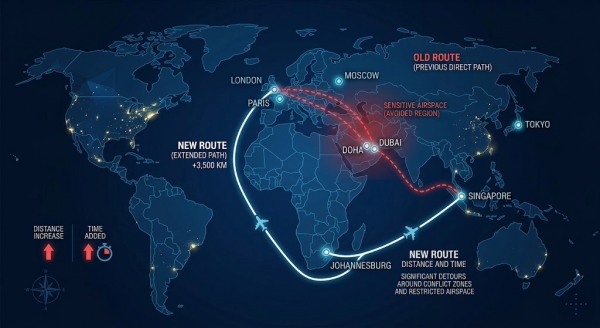
THE SIGNAL: Significant airline service reductions and flight suspensions across Near East airspace are projected to persist potentially through the autumn months. This is a direct, quantifiable effect of heightened regional military tensions between the US/Israel and Iran, leading carriers to enact substantial rerouting protocols.
THE STRATEGIC IMPLICATION: For Private Clients and Global Stakeholders reliant on rapid transit into key hubs (e.g., Dubai, Doha, Abu Dhabi) or using these corridors for onward movement to Europe or Asia, immediate schedule elasticity is mandatory. Existing charter agreements and preferred carrier routes reliant on standard flight paths will face increased lead times, higher contingency fuel loads, and escalating operational costs due to longer flight sectors.
ENTITY ANALYSIS: Primary impact falls on carriers such as Emirates, Qatar Airways, and Etihad, whose hub operations are central to global connectivity. Furthermore, this impacts private aviation operators utilizing common regional refueling and maintenance points. (Note: No specific private asset managers mentioned in the source data.)
TACTICAL PROTOCOL:
- Route Recalibration: Immediately initiate contingency planning for all Q3/Q4 travel involving the region, favoring trans-Atlantic or extended African/Asian arc routes where feasible.
- Charter Audit: Pressure contracted Fixed-Base Operators (FBOs) and charter brokers for transparency on actual flight path deviations and associated fuel/time surcharges.
- Insurance Review: Verify political risk and airspace closure clauses in all relevant travel and asset insurance policies.
- Government Liaison Check: Cross-reference the German Foreign Office advisory (mentioned in the source) against proprietary security assessments for any actionable local restrictions.
THE LONG VIEW: Sustained geopolitical friction mandates a fundamental strategic pivot away from reliance on centralized, single-corridor air logistics. Future infrastructure planning must prioritize redundancy via smaller, more resilient air hubs outside major geopolitical flashpoints, favoring decentralized supply chains for personnel and high-value cargo.